
Your New Home Has Problems. The Real Question Is Whether Anyone's Tracking Them.
By getFIXLY
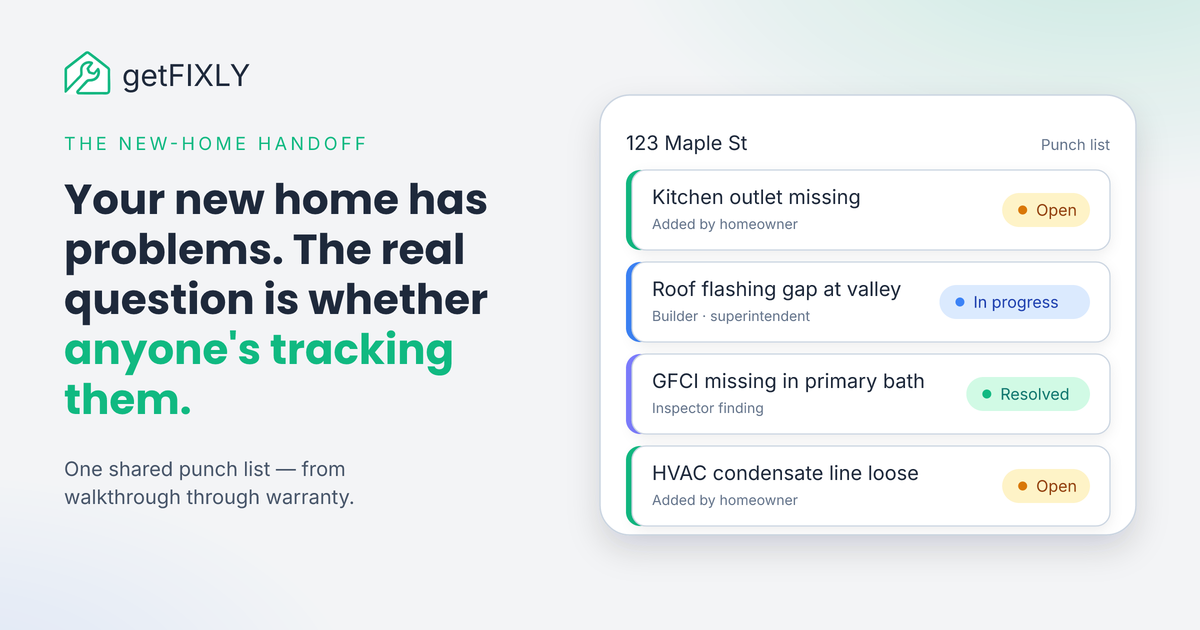
We've spent enough time in and around new construction to know something most first-time buyers don't: your brand-new home isn't perfect. It was never going to be.
That's not a knock on builders. Building a house is one of the most complex manufacturing processes that still happens largely by hand, outdoors, across dozens of trades, over months. Things get missed. Grout lines crack. An outlet doesn't work. Flashing needs adjusting. An HVAC duct comes loose somewhere in the attic.
The industry knows this. That's why punch lists exist. That's why inspections happen. That's why warranties are written into every new-home contract.
The real question isn't whether issues exist — it's whether everyone working to finish the home has a clear, shared way to track and resolve them together.
How the Handoff Works Today
Here's what typically happens when a homeowner closes on a new build.
The inspector walks the house and produces a report — usually a PDF, sometimes 40 or 50 pages long, full of photos and findings. That report gets emailed to the homeowner. The homeowner forwards it to the builder. The builder prints it out, marks it up with a highlighter, and hands sections of it to different subcontractors.
Now the same set of issues is living in four or five different places: the original PDF, someone's email thread, a printed copy on a job site, a text message to the plumber, a sticky note on a superintendent's desk.
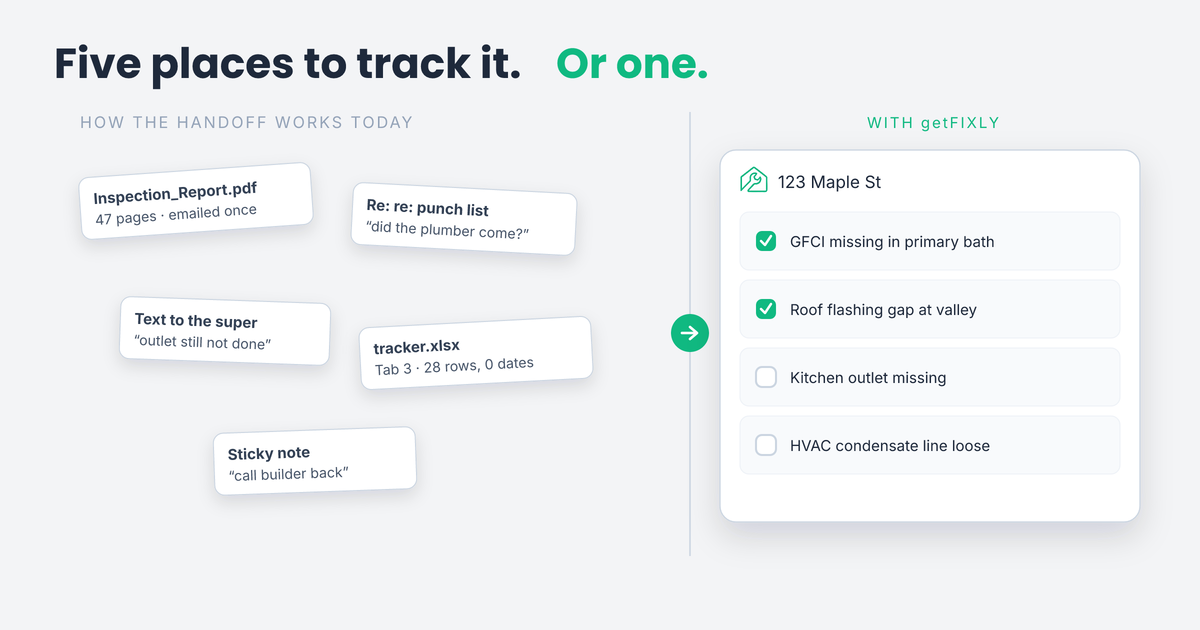
The homeowner starts a spreadsheet. They take their own photos. They send follow-up emails. Some things get resolved quickly. Others take longer to close out, and it's not always clear where things stand. No one has a single view of what's open, what's in progress, and what's done.
Multiply that by the more than 600,000 new single-family homes sold in the U.S. every year, and you start to see the scale of a coordination challenge the whole industry recognizes.
The Builder's Side of the Story
From the builder's side, this coordination challenge is just as real.
A regional builder closing 200 homes a year might be managing thousands of individual punch list items across dozens of active properties. Their superintendents are juggling repair requests that arrive via email, text, phone call, and sometimes a handwritten note left on a kitchen counter.
Without a shared system or structured record, when a warranty claim comes in eight months after closing, the builder has to piece together what was reported and what was resolved — often from memory and scattered email threads.
The best builders care deeply about the post-close experience. They know it drives referrals, online reviews, and repeat business. But the tools they have for managing it are the same ones everyone else uses for everything: email, spreadsheets, and phone calls.
Where Inspector Expertise Deserves to Go Further
Home inspectors do some of the most valuable work in the entire transaction. They walk every room, climb into every attic, check every outlet, and document every defect with photos and notes. A thorough new-construction inspection might turn up 30, 50, even 100+ findings.
But once that report is delivered, the inspector's work is done — and the coordination continues without them. Their carefully documented findings move into the same email-spreadsheet-text-message flow as everything else.
Inspectors know this. Many of them hear from homeowners months later, asking whether something was ever addressed. The inspector has no visibility into what happened after their report left their hands — even though their findings started the whole process.
Warranty Teams Want the Same Thing
By the time a warranty claim lands, weeks or months have passed. The warranty rep handling it wants to make it right — that's the job, and the good ones take it seriously. But they're often working from a thin paper trail, reconstructing what was promised at the walkthrough and what's been done since.
Give them the full history of the home — the original findings, the photos, what was fixed and when — and they can resolve claims faster, with less back-and-forth. That's better for the homeowner, and it protects the builder's reputation, too.
What If Everyone Worked From the Same List?
That's the idea behind getFIXLY.
One shared punch list that stays with the home from the first walkthrough through the warranty period — homeowners, inspectors, builders, and warranty teams all working from the same record instead of through disconnected reports, spreadsheets, texts, and email chains.
When an inspector adds findings, those findings become part of the shared record — not a static PDF that gets forwarded and fragmented. When a builder marks something resolved, the homeowner sees it with the documentation attached. When a warranty claim references an issue from month two, the full history is already there.
It's not about replacing the tools builders and inspectors already use. It's about giving everyone a shared place where issues are tracked, discussed, documented, and resolved — without the coordination overhead that eats up everyone's time and patience.
Less Friction. More Clarity.
The new-home handoff should be one of the most exciting moments of someone's life — the stretch where a brand-new house actually becomes a home. With the right shared system in place, it can stay that way: issues get found, tracked, and resolved with everyone on the same page.
Homeowners, builders, inspectors, and warranty teams are all on the same side here. Everyone wants the same thing — a home that's right, and a handoff that feels like the start of something good. A shared record just makes that easier for all of them.
That's what we're building.
getFIXLY is building the shared system of record for new-home punch lists, defect tracking, and warranty coordination — so the people who build, inspect, and stand behind a home can turn a new house into a home, together. If you're a homeowner, builder, inspector, or warranty pro who's lived through the pain of fragmented repair tracking, we'd love to hear your story. Visit getFIXLY.app to learn more and join the waitlist.